Follow us


Bypassing 403 Forbidden Errors
Description:
The 403 Forbidden HTTP status code indicates that the client was able to communicate with the server, but the server won't let the client access what was requested. In the most general case, the resource the client tried to access might be forbidden using a path based Access Control List. In this video, Dedalo from http://seguridadblanca.org shows us an interesting way to bypass a 403 error. The main idea is to fool the access controller into believing that a different resource was requested, by using "./" in the path of the request. A detailed explanation of why this works is available here.
Thanks go out to Dedalo (camilo.galdos [] security-expert [] se) for submitting this video to us.
Thanks go out to Dedalo (camilo.galdos [] security-expert [] se) for submitting this video to us.
Tags: basics ,
Disclaimer: We are a infosec video aggregator and this video is linked from an external website. The original author may be different from the user re-posting/linking it here. Please do not assume the authors to be same without verifying.
Comments:
Login to post a comment
Video Posted By

ST Course Videos
-
 Defeating Getimagesize() Checks In File Uploads
-
 Challenge 6: Digest Authentication Reloaded
-
 Challenge 5: Digest Authentication Attack
-
 Basic Authentication And Form Bruteforcing
-
 Http Basic Authentication Attack (Easy)
-
 Challenge 2: Http Form Attacks Reloaded
-
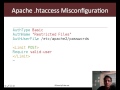 Http Verb Tampering Demo
-
 Web Application Pentesting Course Introduction
-
 Introducing Pentester Academy
-
 Hack Of The Day 13: Remote Shellcode Launcher: Testing Shellcode Over A Network
-
 Hack Of The Day 12: Pivots And Port Forwards In Scenario Based Pentesting
-
 Hack Of The Day: Customizing Shellcode For Fun And Profit
-
 Hack Of The Day: How Do I Run Untrusted Shellcode?
-
 Securitytube Linux Assembly Expert Exam Format
-
 [Slae] Writing An Custom Insertion Encoder
-
 [Slae] Execve Shellcode Stack Method
-
 [Slae] Shellcoding Basics
-
 [Slae] Using Libc And Nasm
-
 [Slae] Hello World In Assembly Language
-
 [Slae] What Is Assembly Language?
